


Henry Noel's Story.
Born December 25, 1888, at Audlem Vicarage. Son of Ursula Mary Atkinson (sister of Sir Edward Cotton-Jodrell) of Audlem Lodge, Broadstone, Dorset. His father, Reverend Canon Arthur Atkinson, was the former Vicar of Audlem.Henry had been a member of Chester Golf Club and had won the Welsh Amateur Golf Championship in 1913. He received his commission in March 1913 and resided at the time at Highfield Hall, Northrop, Flint.
His citation for his DSO appeared in ‘The London Gazette’ on December 1, 1914 and read: ‘For conspicuous gallantry under heavy fire from both flanks by collecting a few men and checking the enemy, thereby facilitating the retirement of his comrades.’ Fought at Mons, Le Cateau and the Aisne. Regarded as the first officer from the Crewe and Nantwich area to fall. After the war, as no grave could be found, his family had a tombstone laid where they believed he had fallen. In February 1923, his body (identified by his disc) was found together with another Cheshire soldier, about 400 yards from where the tombstone had been placed. His body was reinterred in the Cabaret-Rouge British Cemetery, and his tombstone placed in the Violaines Communal Cemetery by the Cheshire Regiment as a perpetual memorial to all those of the Regiment who had no known grave. After his death, it was reputed that his uncle, an influential man in the Cheshire Regiment, War Office and Parliament, had Henry posthumously promoted to Lieutenant.
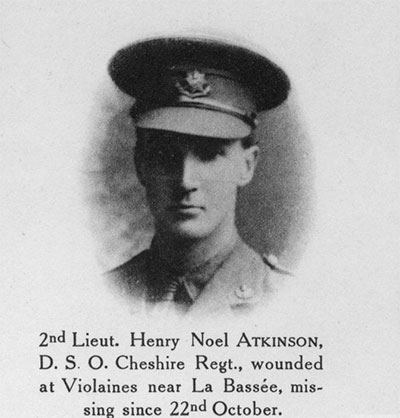
His citation for his DSO appeared in ‘The London Gazette’ on December 1, 1914 and read: ‘For conspicuous gallantry under heavy fire from both flanks by collecting a few men and checking the enemy, thereby facilitating the retirement of his comrades.’ Fought at Mons, Le Cateau and the Aisne. Regarded as the first officer from the Crewe and Nantwich area to fall. After the war, as no grave could be found, his family had a tombstone laid where they believed he had fallen. In February 1923, his body (identified by his disc) was found together with another Cheshire soldier, about 400 yards from where the tombstone had been placed. His body was reinterred in the Cabaret-Rouge British Cemetery, and his tombstone placed in the Violaines Communal Cemetery by the Cheshire Regiment as a perpetual memorial to all those of the Regiment who had no known grave. After his death, it was reputed that his uncle, an influential man in the Cheshire Regiment, War Office and Parliament, had Henry posthumously promoted to Lieutenant.