


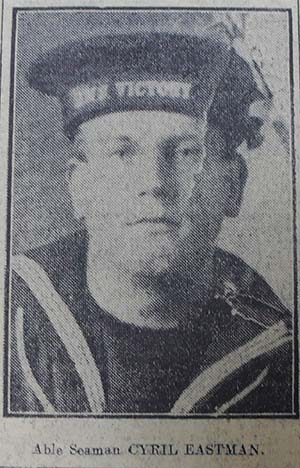
Cyril William's Story.
Birkenhead News 3 February 1915
Another Birkenhead “Viknor” victim
Mrs. Eastman, of 64, The Woodlands, Birkenhead, has just been the recipient of the news that her son Able Seaman Cyril Eastman was one of the unfortunate victims of the wreck H.M.S. Viknor. Deceased, who was only 21 years of age, volunteered for service the day hostilities were declared with the Royal Naval Volunteers. After seeing active service, being present at the fall of Antwerp, he was transferred to the Viknor, and was on the ill-fated ship when she sank somewhere off the Irish coast. Previous to joining the Navy Able Seaman Eastman was employed as a store-keeper by Cammell Lairds. He was well liked and respected, and leaves a large circle of friends.
HMS Viknor
Built in 1888 and originally named RMS Atrato she operated as Royal Mail Ship and ocean liner. In 1912 the ship was sold to a cruise company and renamed The Viking. With the outbreak of war in 1914 she was requisitioned by the Admiralty, armed as merchant cruiser, and renamed HMS Viknor.
During the first weeks of 1915 the HMS Viknor was patrolling off the north coast of Scotland when she was ordered to intercept a neutral Norwegian vessel, who the military suspected was carrying a German spy. HMS Viknor began to return to port in Liverpool; however on 13th January in heavy seas off Tory Island, County Donegal, she sank without sending a distress signal. All the crew aboard were lost. Some wreckage and many bodies were washed ashore on the north coast of Ireland and Scotland.
It has never been fully established the cause of the sinking, however the wreck was discovered in 2006 by an Irish survey vessel and because of the location it is thought that the Viknor may have struck a German mine, as a minefield was known to be in the vicinity.
Cyril Eastman's photograph, research and newspaper article by Chris Booth