


Thomas's Story.
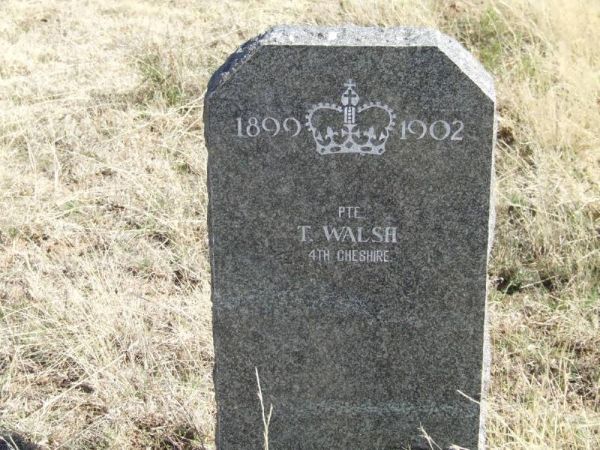
Private Thomas Walsh of the 4th Btn Cheshire Regiment regimental number 2629 (sometimes wrongly cited as 7629) died of typhoid (enteric fever) on 9th June 1900. He was 38 years old. He is buried in the Concentration Camp Memorial & British War Graves, Springfontein, Free State, South Africa.
Thomas was the son of Patrick and Mary Walsh, who came from County Mayo, Ireland. Thomas was born in Stockport in the summer of 1862, and was brother to Ann (1851 - ), Honor (known confusingly as Annie, 1853 - ) John (1858 - ) Richard (1858 - ) and Mary (1865 - ). In April 1871, at the age of 9, he was living at 15 Back Duke Street, Stockport, and ten years later the family home was at 3 Malmesbury Court. By then, 19-year-old Thomas was a Cotton Throstle Doffer. (For more information on this occupation, scroll to the very end)
The family history becomes slightly complicated: the family surname is variously recorded on the census and on birth and marriage registrations as Walsh, Welsh and Welch. His elder sister Honor, known as Annie, married William Moran on 18th May 1872, his youngest sister Mary married William Kenny in 1889, and his eldest sister Ann Walsh married John Bond. She is certainly a different person from Annie / Honor. .... The 1891 census shows Thomas and his unmarried brother Richard living with their parents at 3 Malmesbury Court, Stockport.
The family history becomes slightly complicated: the family surname is variously recorded on the census and on birth and marriage registrations as Walsh, Welsh and Welch. His elder sister Honor, known as Annie, married William Moran on 18th May 1872, his youngest sister Mary married William Kenny in 1889, and his eldest sister Ann Walsh married John Bond. She is certainly a different person from Annie / Honor. .... The 1891 census shows Thomas and his unmarried brother Richard living with their parents at 3 Malmesbury Court, Stockport.
The 4th Battalion the Cheshire Regiment was embodied for service in the Second Anglo Boer War in January 1900. They sailed for South Africa on the SS Orotava on 24th February 1900, setting off from Queenstown in Ireland (modern day Cobh, County Cork) arriving in Cape Town about three weeks later, on 16th March.
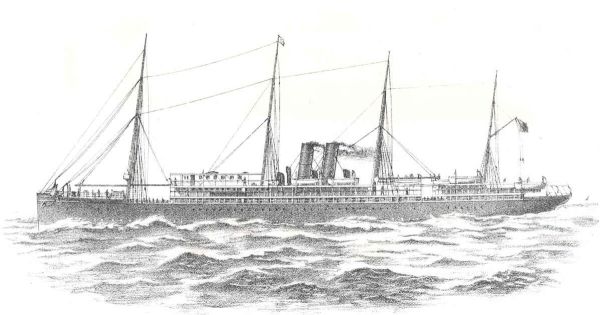
The Orotava arrived at Queenstown Saturday (24th Feb 1900) and embarked 23 officers and 516 men of the 3/Norfolk Regiment, and 26 officers and 627 men of the 4/Cheshire Regiment. (London Times Feb 1900)
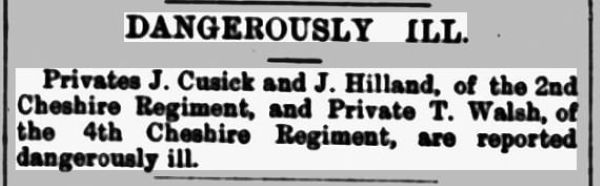
Within three months of arriving in Souh Africa, Thomas was reported to be dangerously ill with typhoid, and he died on 9th June. He is buried in the cemetery at Springfontein. His mother received the news by a letter from the War Office on August 7th 1900, shortly after they had been telegraphed the casualty list from South Africa. She died in Stockport Union Workhouse, Cheshire on 23rd April 1901, just ten months after Thomas's death.
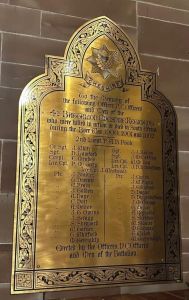
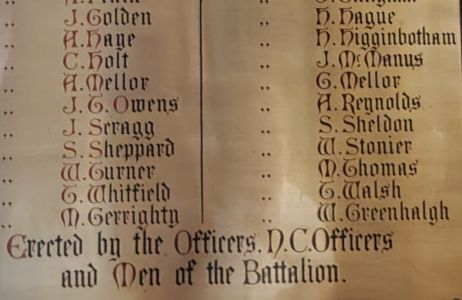
As a member of the 4th Btn Cheshire Regiment, Thomas is remembered on a plaque in the south porch of St Michael and All Angels Church in Macclesfield.
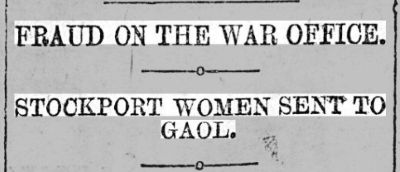
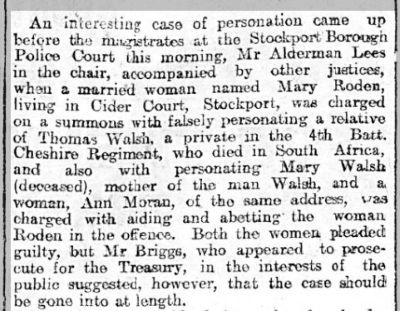
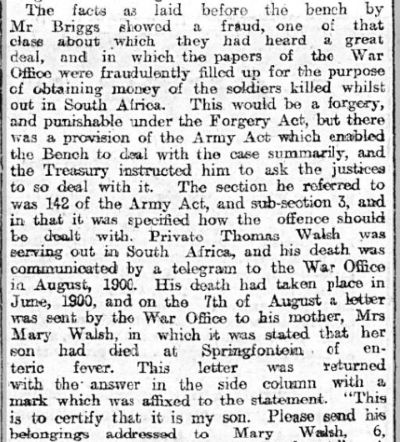
Fraud Case in Stockport 1901
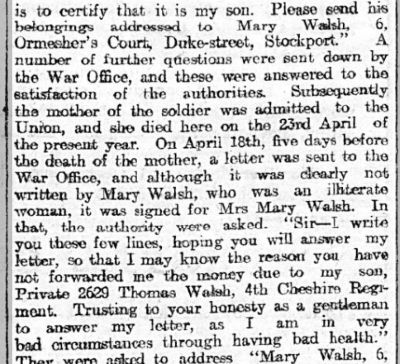
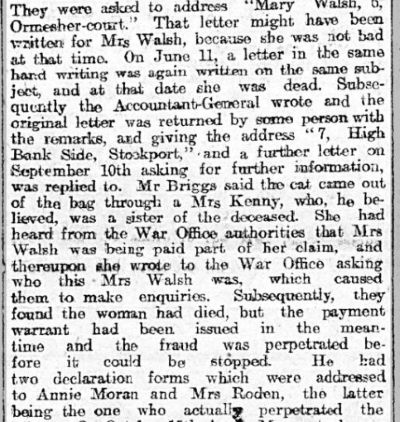
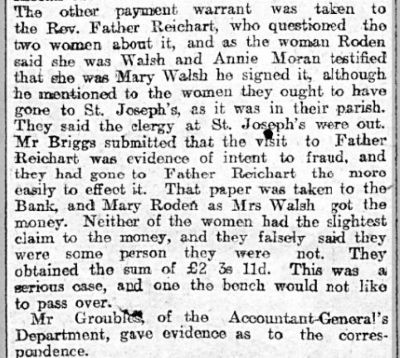
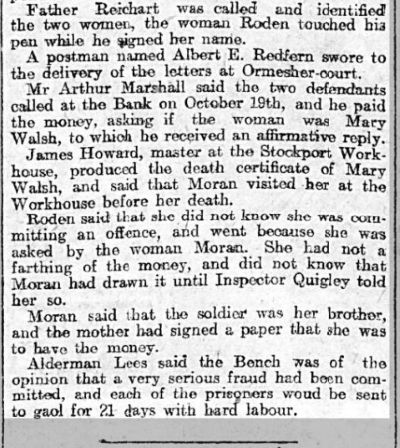
After his death on active service, Thomas's mother was entitled to payments from the War Office, and before she died she responded to their letters, giving her address in Stockport as 6 Ormesher Court, Back Duke Street. As she was illiterate, the letter was scribed for her. After she moved into the Stockport Union Workhouse, it appears that one of her daughters - Annie (Honor) Moran, who still lived at 6 Ormesher Court - forged another letter asking for payments to be made to her at a different address, 7 High Bank Side. The daughter persuaded an older woman Mary Roden to impersonate her mother, who by then had died in April 1901. The two women were arrested after another daughter Mrs Mary Kenny contacted the War Office and alerted them that her mother had died. Mary Roben and Annie Moran were each sentenced to three weeks hard labour. (From the letters written, we know that the correct regimental number for Thomas was 2629.)
NB There was a Mary Roden aged 38 living at 4 Cider Court in 1901, and two doors away, on an adjacent street, another lady Ann Roden aged 66.
NB There was a Mary Roden aged 38 living at 4 Cider Court in 1901, and two doors away, on an adjacent street, another lady Ann Roden aged 66.
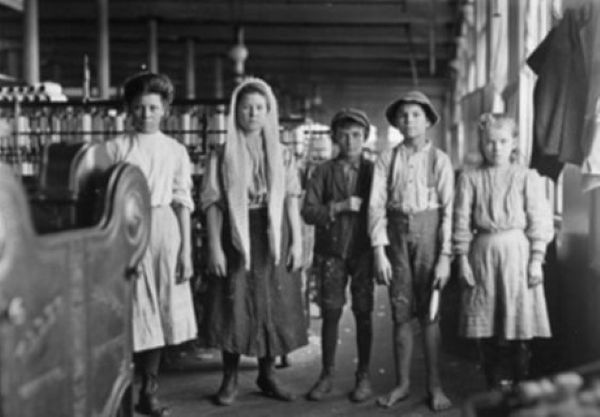
19-year-old Thomas was a Cotton Throstle Doffer. This occupation's primary role was to remove the full bobbins of spun yarn from the throstle frame and replace them with empty ones. This was a repetitive and physically demanding task, often performed by young workers, sometimes children.
Cotton Throstle Doffing
A "Cotton Throstle Doffer" was a worker in a cotton mill, specifically responsible for the doffing process on a throstle spinning frame. Doffing involved removing full bobbins (spindles holding spun yarn) from the machine and replacing them with empty ones. The throstle frame was a type of spinning machine, and the doffer's role was crucial in maintaining the continuous operation of the machine by ensuring a constant supply of empty bobbins.
Throstle Frame:
This was a type of cotton spinning machine known for its continuous action, where drawing, twisting, and winding processes occurred simultaneously. It was an improvement on the water frame and often powered by steam engines. The name "throstle" is said to have come from the humming sound the machine made, similar to the song of a thrush bird.
Researched by Shena Lewington (August 2025)