


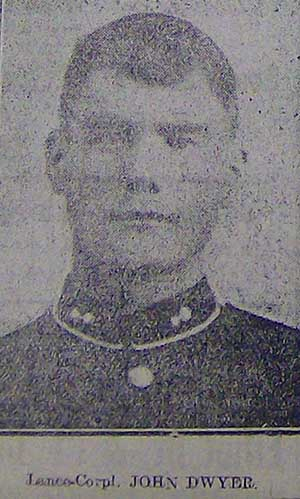
John 's Story.
John Francis Dwyer was born in 1888 in Birkenhead to parents Francis and Martha. He had one brother and four sisters. By 1901 the family were living at 29 Connaught Street, Birkenhead.In 1905, at the young age of 17, John joined the Militia with the 3rd Battalion Cheshire Regiment. A year later he enlisted in the regular army with the 2nd Battalion, Royal Welsh Fusiliers
He served in the U.K for nearly three years until January 1909 when along with his Battalion he was posted to India. In 1911 John was stationed in a town called Quetta, which is in modern day Pakistan.
With the clouds of war looming in the early part of 1914, John’s Battalion along with many others in the regular army were recalled to the UK, landing in March of that year. Six days after Britain declared war on Germany and her on the 4th August 1914 John and his unit were despatched for France. He took part in many of the early battles of the First World War – Mons and the Aisne in 1914, and Loos and Festubert in 1915. In the July of that year John was wounded for the first time.
The Royal Welsh Fusiliers were moved to the Somme in the middle of July 1916 to take part in that battle which had been raging since the 1st of that month. It was not long after his arrival on the Somme that Lance Corporal Dwyer was awarded the Military Medal on or around the 18th July. His battalion were positioned around the French town of Bazetin-Le-Petit in preparation for an attack on the German lines in High Wood. It was during this action that he gained the medal for ‘gallantry and devotion to duty’.
In November of 1916 the Royal Welsh Fusiliers were still on the Somme and during heavy shelling on the 3rd John was wounded by a shell fragment in his right leg. The wound was severe enough that he was taken to a hospital behind the lines and then sent back to the UK. His injury was sufficiently debilitating that he was discharged from the Army on Christmas Day 1917.
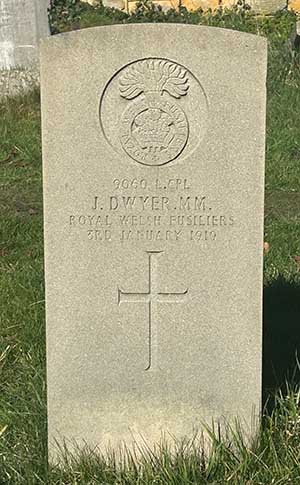
However, only a few weeks after the end of the war John died on 3rd January 1919 from a combination of pneumonia and septic wounds of leg (a result of injuries received during his war service).
John’s brother Moses also served in the Army with the Cheshire Regiment. He went to Gallipoli in August 1915 and thankfully survived the war. Moses died in 1960.
John's grave in Flaybrick Cemetery, Birkenhead
Research and picture by Chris