


Peter's Story.
Private Peter Lee (real name Peter Maddock) 1015 of the 1st King's Royal Rifles, died of typhoid on 30th March 1900, aboard the SS Lismore Castle on his way back to the UK. He was 23 years old. His death was reported in the Chorley Guardian, his local paper:
DEATH OF A LOCAL SOLDIER.
Yesterday week on board the steamship Lismore Castle at the Cape, among the deaths recorded from enteric fever was that of 1015 Private P. Lee, of the 1st King's Royal Rifles, and who was 23 years of age. He formerly lived at Adlington, and his sisters now reside with their uncle and aunt, Mr. and Mrs. F. Garstang, 8, Victoria-street, Chorley. The deceased, whose proper name was Peter Maddock, joined the army two years ago, and went through the campaign in Natal under General White. He took part in the battle of Talana Hill, the famous night march of General Yule, and also in the siege of Ladysmith. His relatives last heard from him in November, when he sent an account of the battle of Talana Hill, which appeared in the Guardian on December 3rd. (Chorley Guardian, Saturday 7th April 1900)

Casualty list in various newspapers
Casualty list in various newspapers
What do we know about Peter?
Peter Maddock (enlisted name falsely given as P. Lee) was born on 12th September 1876, the eldest son of Thomas Maddock (1854 - 1928) and Jane Watson (1854–1889). He was baptised on 7th January 1877 in Blackrod, Lancashire. His father's family had moved to the Chorley area in the 1860s from Oakmere, near Northwich. It was then in the parish of Delamere. This seems to be Peter's link to Northwich, and might explain why he is commemorated on the Boer War memorial at St Helen's Church, Northwich.

Peter had three surviving sisters - Martha, Mary and Ellen, and they grew up at Common End, Adlington, Lancashire. When he was 12 years old, his mother Jane died (aged 34) and his father remarried six months later, on 5th August 1889, to Betsy Hitchins. By 1900, all the children of Thomas's first marriage were living with an aunt and uncle, Annie and Francis Walter Garstang, at 8 Victoria Street, Chorley. (Peter's aunt Annie nee Maddock was his father's younger sister.)
Peter's father was born in Delamere, near Northwich. He was a coal miner, and Peter followed him into that occupation. On 26th November 1896, aged twenty, he enlisted into the Royal Navy for a 12 year term, but absconded from HMS Victoria II after a month, on 19th December 1896. He was apprehended in January 1897, and given a 28 day prison sentence, before being discharged on 27th February. This may explain why he used a false name when he enlisted into the King's Royal Rifles in 1898. From his naval records, we know he had brown hair, grey eyes and was 5' 3" tall.
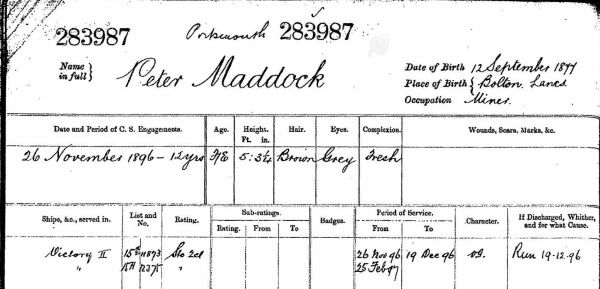
Some months later, when he was about 21 and presumably still living near Southampton in Hampshire, Peter enlisted into the 1st King's Royal Rifles, a Hampshire regiment, under the name P. Lee. His attestation papers would show whether he also gave a false place of birth, possibly Delamere, Oakmere, Weaverham or Northwich, in Cheshire, where his father's family had come from.
According to the newspaper article in the Chorley Guardian, Peter "joined the army two years ago (ie in 1898), and went through the campaign in Natal under General White. He took part in the battle of Talana Hill, the famous night march of General Yule, and also in the siege of Ladysmith. His relatives last heard from him in November 1899, when he sent an account of the battle of Talana Hill, which appeared in the Guardian on December 3rd 1899".
Peter's account of the Battle of Talana Hill can be read in full further down, together with another contemporary description which also appeared in the newspapers in December 1899. Peter wrote:
"We came in contact with the rifle fire of the enemy, which was just like rain falling at our feet, and WHISTLING PAST OUR FACES. We thought our time had come then. It was a run of a quarter of a mile for either death or glory. Some got glory but some of them got death. We had 110 killed and wounded, and most of my draft were among them."
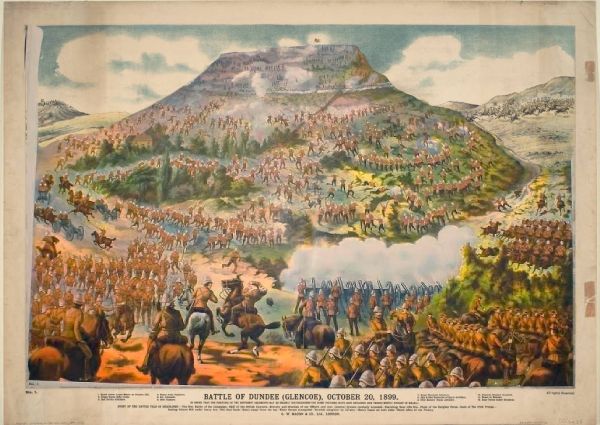
The other writer (a post office worker) reported that he "went up the hill with the burial party, and saw 22 of our men and eight officers lying dead. Some had been killed by our own shell just as they had gained the summit of the hill, and their wounds were ghastly. I shall never forget the sight to my dying day. The hill was extremely difficult to climb, and how our fellows managed to climb over the great boulders with their rifles, and under a deadly fire from the Boers, is a mystery. The Boers had also taken possession of a conical hill at right angles to Talana Hill, and they poured in a merciless cross fire."
Peter survived this battle, but on his way back to the UK aboard the hospital ship SS Lismore Castle, he succumbed to enteric fever (typhoid) and died on 30th March 1900. He was 23 years old. He was almost certainly buried at sea.
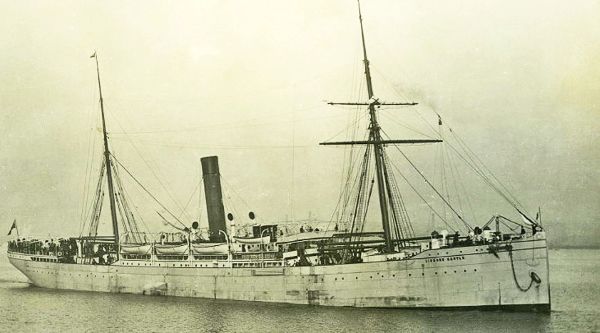
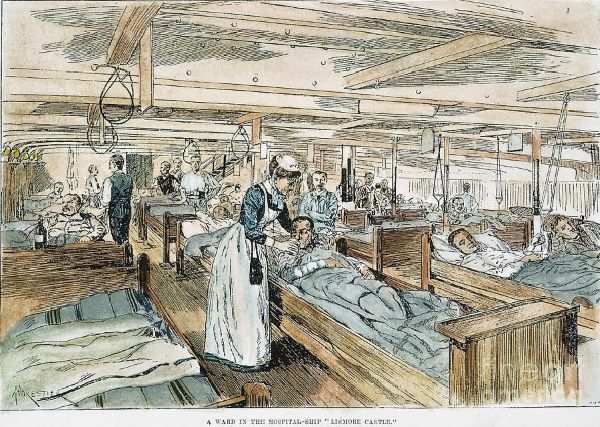
Peter is remembered on the plaque at St Helen's Church in Northwich. His link to Northwich seems to be that his father was born at Delamere, and the Maddock family originally came from Northwich.
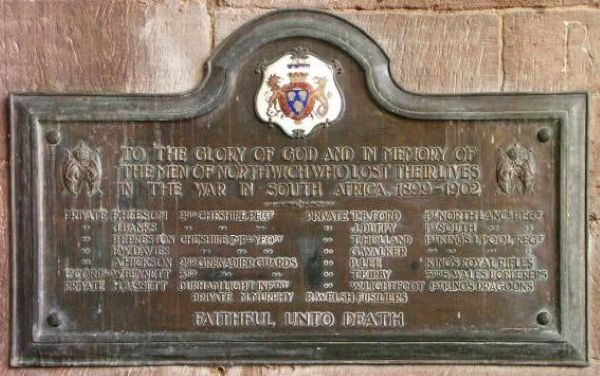
Northwich memorial
His name is also inscribed in the Kings Royal Rifles Memorial Book at Winchester Cathedral in Hampshire.
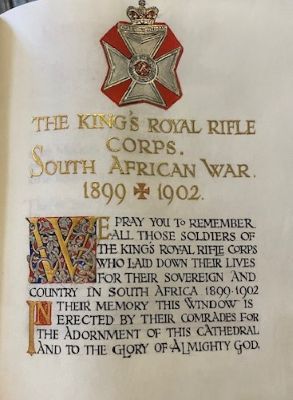
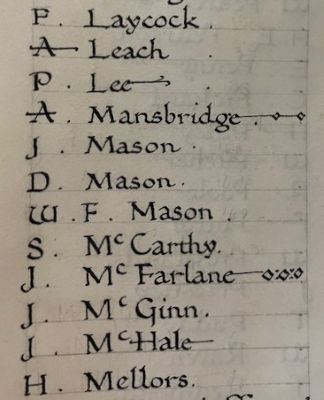
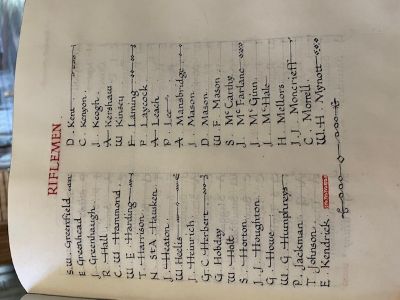
Entries from the memorial book at Winchester Cathedral
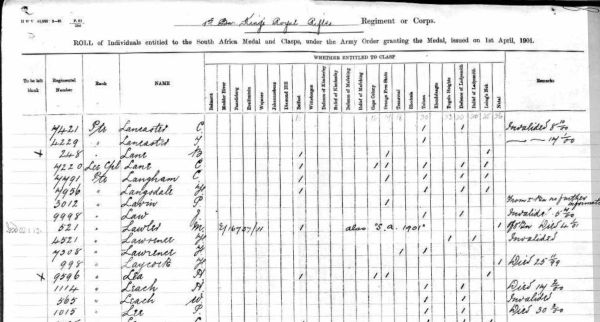
Peter was posthumously awarded the Queen's South Africa medal, with clasps for Talana and Ladysmith.
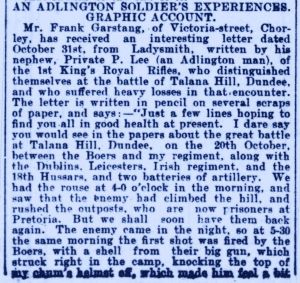
Peter's account of the Battle of Talana Hill was sent to the Chorley Guardian by his uncle Frank Garstang, and published in December 1899:
AN ADLINGTON SOLDIER'S EXPERIENCES. GRAPHIC ACCOUNT.
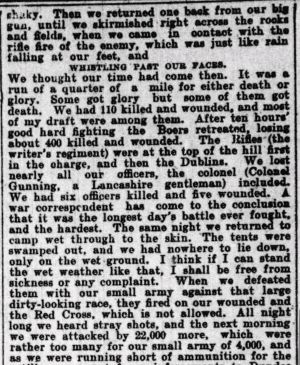
Mr. Frank Garstang, of Victoria-street, Chorley, has received an interesting letter dated October 31st, from Ladysmith,written by his nephew, Private P. Lee (an Adlington man), of the 1st King's Royal Rifles, who distinguished themselves at the battle of Talana Hill. Dundee, and who suffered heavy losses in that encounter. The letter is written in pencil on several scraps of paper, and says:-"Just a few lines hoping to find you all in good health at present. I dare say you would see in the papers about the great battle at Talana Hill, Dundee, on the 20th October. between the Boers and my regiment, along with the Dublins. Leicesters, Irish regiment. and the 18th Hussars, and two batteries of artillery. We had the rouse at 4 o'clock in the morning, and saw that the enemy had climbed the hill. and rushed the outposts, who are now prisoners at Pretoria. But we shall soon have them back again. The enemy came in the night, so at 5-30 the same morning the first shot was fired by the Boers,with a shell from their big gun, which struck right in the camp, knocking the top of a chum's helmet off, which made hin feel a bit shaky. Then we returned one back from our big gun, until we skirmished right across the rocks and fields,when we came in contact with the rifle fire of the enemy, which was just like rain falling at our feet, and WHISTLING PAST OUR FACES.
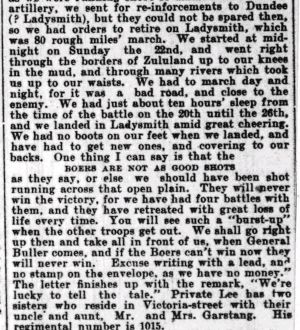
We thought our time had come then. It was a run of a quarter of a mile for either death or glory. Some got glory but some of them got death. We had 110 killed and wounded, and most of my draft were among them. After ten hours' good hard fighting the Boers retreated, losing about 400 killed and wounded.The Rifles (the writer's regiment) were at the top of the hill first in the charge, and then the Dublins. We lost nearly all our officers. the colonel (Colonel Gunning, a Lancashire gentleman) included. We had six officers killed and five wounded. A war correspondent has come to the conclusion that it was the longest day's battle ever fought and the hardest. The same night we returned to camp wet through to the skin. The tents were swamped out, and we had nowhere to lie down, only on the wet ground. I think if I can stand the wet weather like that, I shall be free from sickness or any complaint. When we defeated them with our small army against that large dirty-looking race, they fired on our wounded and the Red Cross, which is not allowed. All night long we heard stray shots, and the next morning we were attacked by 22,000 more, which were rather too many for our small army of 4,000, and as we were running short of ammunition for the artillery. we sent for reinforcements to Dundee (? Ladysmith), but they could not be spared then, so we had orders to retire on Ladysmith, which was 80 rough miles' march. We started at midnight on Sunday the 22nd, and went right through the borders of Zululand up to our knees in the mud, and through many rivers which took us up to our waists. We had to march day and night, for it was a bad road, and close to the enemy. We had just about ten hours' sleep from the time of the battle on the 20th until the 26th. and we landed in Ladysmith amid great cheering.
We had no boots on our feet when we landed, and have had to get new ones, and covering to our backs. One thing I can say is that the BOERS ARE NOT AS GOOD SHOTS as they say, or else we should have been shot running across that open plain. They will never win the victory, for we have had four battles with them, and they have retreated with great loss of life every time. You will see such a"burst-up' when the other troops get out. We shall go right up then and take all in front of us, when General Buller comes, and if the Boers can't win now they will never win. Excuse writing with a lead, and no stamp on the envelope, as we have no money". The letter finishes up with the remark,"We're lucky to tell the tale." Private Lee has two sisters who reside in Victoria-street with their uncle and aunt, Mr. and Mrs. Garstang. His regimental number is 1015.
Another account of the Battle of Talana Hill appeared in the Chester Chronicle on 2nd December 1899, from a letter sent to Mrs Thompson of Hough Green, Chester, perhaps by a relation of hers in South Africa.
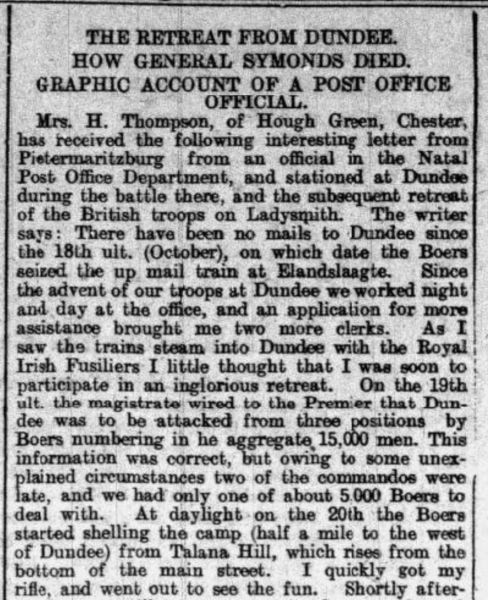
THE RETREAT FROM DUNDEE. GRAPHIC ACCOUNT OF A POST OFFICE OFFICIAL
Mrs. H. Thompson, of Hough Green, Chester has received the following interesting letter from Pietermaritzburg from an official in the Natal Post Office Department, and stationed at Dundee during the battle there, and the subsequent retreat of the British troops on Ladysmith. The writer says:
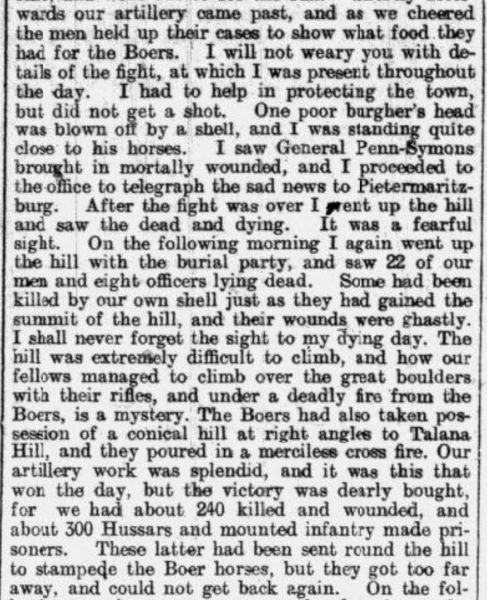
There have been no mails to Dundee since the 18th ult. (October 1899), on which date the Boers seized the up-mail train at Elandslaagte. Since the advent of our troops at Dundee we worked night and day at the office, and an application for more assistance brought me two more clerks. As I saw the trains steam into Dundee with the Royal Irish Fusiliers. I little thought that I was soon to participate in an inglorious retreat. On the 19th ult. the magistrate wired to the Premier that Dundee was to be attacked from three positions by Boers numbering in the aggregate 15,000 men. This information was correct, but owing to some unexplained circumstances two of the commandos were late, and we had only one of about 5,000 Boers to deal with. At daylight on the 20th, the Boers started shelling the camp (half a mile to the west of Dundee) from Talana Hill, which rises from the bottom of the main street. I quickly got my rifle, and went out to see the fun. Shortly afterwards our artillery came past, and as we cheered the men held up their cases to show what food they had for the Boers. I will not weary you with details of the fight, at which I was present throughout the day. I had to help in protecting the town, but did not get a shot. One poor burgher's head was blown off by a shell, and I was standing quite close to his horses. I saw General Penn-Symons brought in mortally wounded, and I proceeded to the office to telegraph the sad news to Pietermaritzburg. After the fight was over I went up the hill and saw the dead and dying. It was a fearful sight.
On the following morning I again went up the hill with the burial party, and saw 22 of our men and eight officers lying dead. Some had been killed by our own shell just as they had gained the summit of the hill, and their wounds were ghastly. I shall never forget the sight to my dying day.
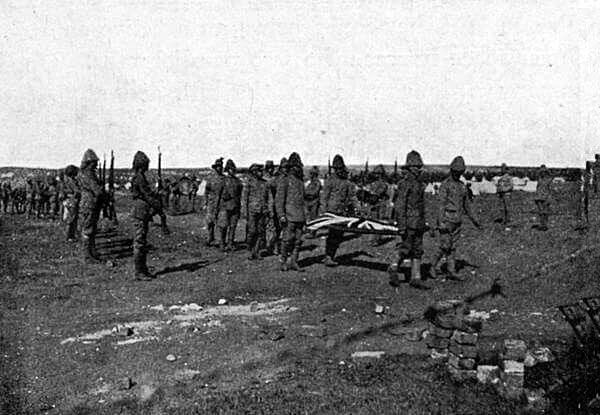
(Talana Hill 1899 Dublin-Fusiliers burial party giving last-rites)
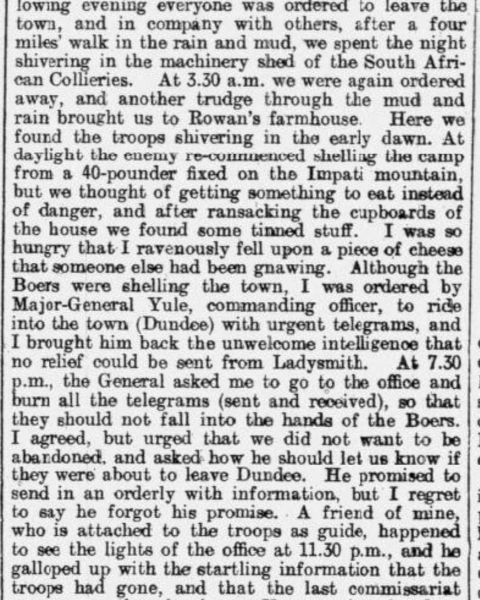
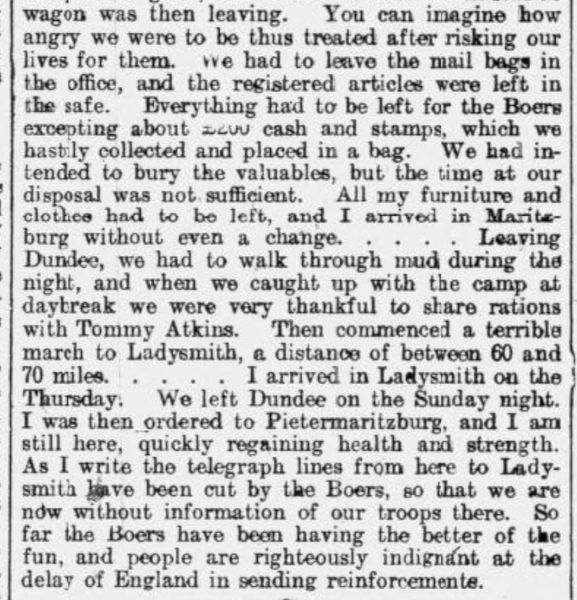
The hill was extremely difficult to climb, and how our fellows managed to climb over the great boulders with their rifles, and under a deadly fire from the Boers, is a mystery. The Boers had also taken possession of a conical hill at right angles to Talana Hill, and they poured in a merciless cross fire. Our artillery work was splendid, and it was this that won the day, but the victory was dearly bought, for we had about 240 killed and wounded, and about 300 Hussars and mounted infantry made prisoners. These latter had been sent round the hill to stampede the Boer horses, but they got too far away, and could not get back again. On the following evening everyone was ordered to leave the town, and in company with others, after a four miles' walk in the rain and mud, we spent the night shivering in the machinery shed of the South African Collieries. At 3.30 a.m. we were again ordered away, and another trudge through the mud and rain brought us to Rowan's farmhouse. Here we found the troops shivering in the early dawn. At daylight the enemy re-commenced shelling the camp from a 40-pounder fixed on the Impati mountain, but we thought of getting something to eat instead of danger, and after ransacking the cupboards of the house we found some tinned stuff. I was so hungry that I ravenously fell upon a piece of cheese that someone else had been gnawing. Although the Boers were shelling the town, I was ordered by Major-General Yule, commanding officer, to ride into the town (Dundee) with urgent telegrams, and I brought him back the unwelcome intelligence that no relief could be sent from Ladysmith. At 7.30 pm, the General asked me to go to the office and burn all the telegrams (sent and received), so that they should not fall into the hands of the Boers. I agreed, but urged that we did not want to be abandoned. and asked how he should let us know if they were about to leave Dundee. He promised to send in an orderly with information, but I regret to say he forgot his promise. A friend of mine, who is attached to the troops as guide, happened to see the lights of the office at 11.30 p.m., and he galloped up with the startling information that the troops had gone, and that the last commissariat wagon was then leaving. You can imagine how angry we were to be thus treated after risking our lives for them. we had to leave the mail bags in the office, and the registered articles were left in the safe. Everything had to be left for the Boers excepting about £200 cash and stamps, which we hastily collected and placed in a bag. We had intended to bury the valuables, but the time at our disposal was not sufficient. All my furniture and clothes had to be left, and I arrived in Maritzburg without even a change.
Leaving Dundee, we had to walk through mud during the night, and when we caught up with the camp at daybreak, we were very thankful to share rations with Tommy Atkins. Then commenced a terrible march to Ladysmith, a distance of between 60 and 70 miles. I arrived in Ladysmith on the Thursday. We left Dundee on the Sunday night. I was then ordered to Pietermaritzburg, and I am still here, quickly regaining health and strength. As I write the telegraph lines from here to Ladysmith have been cut by the Boers, so that we are now without information of our troops there. So far, the Boers have been having the better of the fun, and people are righteously indignant at the delay of the English in sending reinforcements. (Chester Chronicle, 2nd December 1899)
(Chester Chronicle, 2nd December 1899)
Researched by S.Lewington (June 2025) With thanks to Winchester Cathedral for the images of the Kings Royal Rifles Memorial Book.