


Charles Henry's Story.
118 First Grade Orderly Charles Henry Powell, St. John Ambulance Brigade, died on 4th January 1901 at Netley Military Hospital, near Southampton, of enteric fever and pneumonia. He was 22. He was buried at Coppenhall Cemetery, Crewe, Cheshire on January 9th.
What do we know about Charles?
Charles Henry Powell was born in Crewe in January 1879, the eldest child of Charles Powell (1854 - ) and Mary Hannah nee Parks (1858 - 1886). His father was a steam engine brass finisher. His parents had married on 28th Dec 1876 at Leighton cum Minshull Vernon, Cheshire. Charles was baptised on 9th Feb 1879 at Church Coppenhall, Crewe. In April 1881, Charles senior and Mary Hannah were living at Coppenhall Road with their two eldest children, Charles and Gertrude Annie (24 Apr 1880 - 1964).
In 1886, when he was nine years old, his mother Mary Hannah died, and in 1887 his father married Margaret Ann Brocklehurst (1858 - 1901). (Margaret had been a witness at his first marriage to Mary). In April 1891, the family was living at Walnut Villas, on a road then named Bridge Street, now Bradfield Road, Monks Coppenhall, Crewe. Charles was 12 years old, and still at school. By then he had a younger brother Edwin (1883 – 1864).
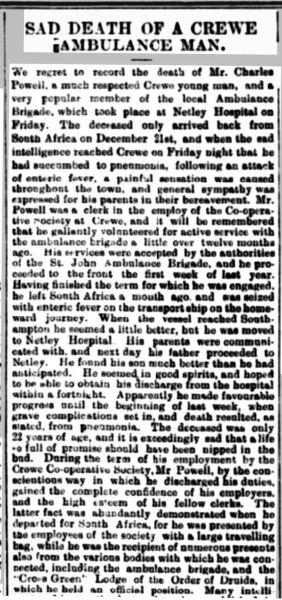
Charles worked as a clerk for the Co-operative Society in Crewe. When he was sent to South Africa in January 1900, as a volunteer for the St John Ambulance, his colleagues at the Co-op presented him with a large travelling bag, and other local groups (including the Crewe St John Ambulance Brigade and the Order of Druids Friendly Society) gave him presents to send him on his way.
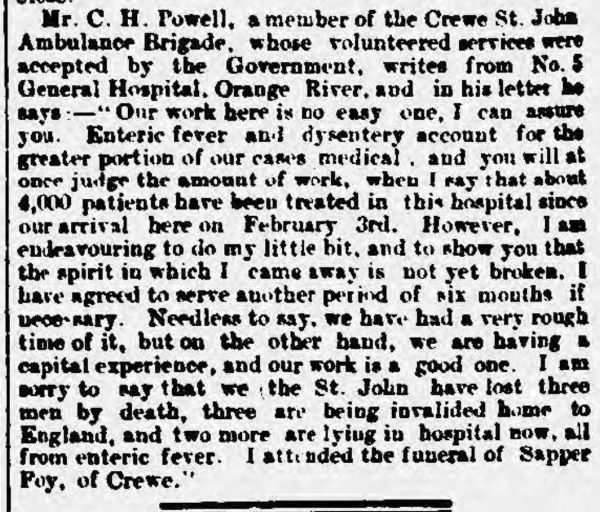
Charles Henry Powell wrote two letters home that appeared in the local papers in the summer of 1900. His first was from No.5 General Hospital, Orange River.
“Our work here is no easy one, I can assure you. Enteric fever and dysentery account for the greater portion of our medical cases and you will at once judge the amount of work, when I say that about 4,000 patients have been treated in this hospital since our arrival on February 3rd. ...... I have agreed to serve another period of six months if necessary ..... I am sorry to say that we (the St. John) have lost three men by death, three are being invalided home to England and two more are lying in hospital now, all from enteric fever.”
Runcorn Guardian 7th July 1900.
On 12th June 1900, Charles wrote again, this time from No.3 General Hospital, Kroonstad, where he was attached to RAMC:
“I think the event which caused greatest excitement and the greatest display of patriotism was the Relief of Mafeking, When the news was confirmed everybody (except the Boers) appeared overcome with joy, But we who are engaged in hospital work are often bearers of news which is not joyous and in many cases, as in the present, most sad. I refer to the illness and death of one of our Crewe Engineers, Sapper Foy at Orange River. Although not actually under my care I often visited him and endeavoured to cheer him up by retailing scraps of home news, and as a last token of respect for him, as the only Crewe person at Orange River, followed him to his last resting place.”
Shortly before he left South Africa, Charles was given a promotion to Corporal. (See the article in the Crewe Chronicle)
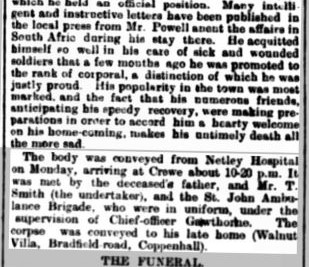
"Many intelligent and instructive letters have been published in the local press from Mr Powell about the affairs in South Africa during his stay there. He acquitted himself so welll in his care of sick and wounded soldiers that a few months ago he was promoted to the rank of corporal, a distinction of which he was justly proud. His popularity in the town was most marked, and the fact that his numerous friends, anticipating his speedy recovery, were making preparations in order to accord him a hearty welcome on his home-coming, makes his untimely death all the more sad."
The Crewe Chronicle Jan 12th 1901
Charles Henry Powell returned to the UK on December 21st 1900, and appeared to be making a good recovery from enteric fever, which he caught on the homeward-bound transport ship. His father visited him in hospital and he was expecting to be discharged within a fortnight. Plans were in place for a celebration by friends and colleagues in Crewe to welcome him home. However, he suffered a relapse and died of pneumonia on 4th January 1901 at Netley Military Hospital, also known as the Royal Victoria Hospital, near Southampton. He was 22.
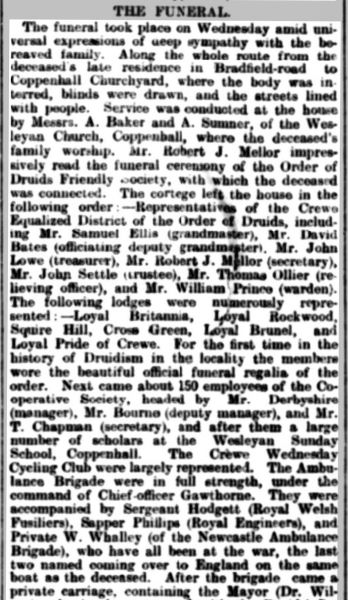
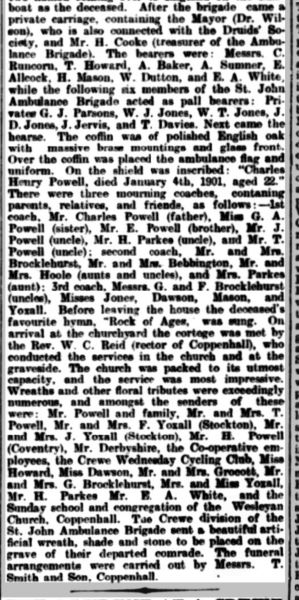
Charles's body was brought back to Crewe, and he was buried at Coppenhall Cemetery, Cheshire on January 9th 1901, in a funeral ceremony attended by many people, including the mayor. The church was full - "packed to the utmost capacity" and the St John Ambulance Brigade were in attendance. Sadly, his stepmother Margaret died just a fortnight later, aged 42, and was buried at the same cemetery on 29th January 1901.
On 31st March 1901, his recently widowed father Charles Powell (aged 47) who had lost both his eldest son and his second wife two months earlier, was still living at Walnut Villas, 210 Bradfield Road, Monks Coppenhall, near Crewe, with his surviving son Edwin 17, and daughter Gertrude Annie 20. In 1902, Charles senior married for a third time and had another son, called Charles Wilfred Powell (1906 - 1987). In 1903, Gertrude married James Robinson and had several sons.
Newspaper mentions:
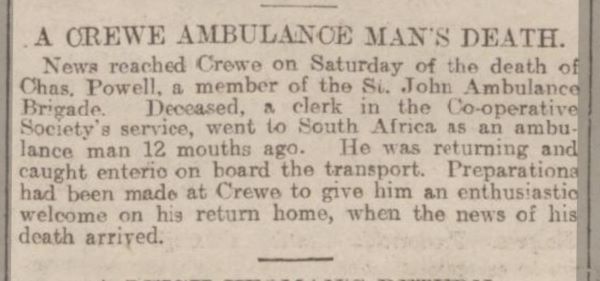
CREWE AMBULANCE MAN’S DEATH. News reached Crewe on Saturday of the death of Chas. Powell, a member of the St. John Ambulance Brigade. Deceased, clerk in the Co-operative Society's service, went to South Africa as an ambulance man ....
Manchester Courier 7th Jan 1901
Crewe Chronicle 12th January 1901:
To check:
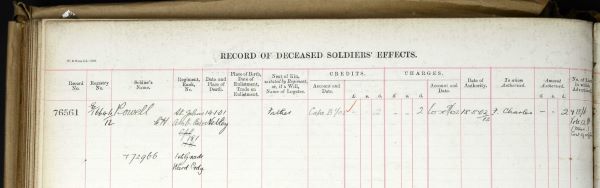
The Army Record of Deceased Soldiers’ Effects lists a Corporal C H Powell of St John Ambulance who died on 14th January 1901 at Netley Hospital. His regimental number of 118 has been crossed out on the record and replaced with 181. Is this a coincidence or the same person wrongly recorded?
Compiled by S. Lewington
Acknowledgements to “From Crewe to the Cape” by Mark Potts, Tony Marks and Howard Curran for much of this information.
What do we know about Charles?
Charles Henry Powell was born in Crewe in January 1879, the eldest child of Charles Powell (1854 - ) and Mary Hannah nee Parks (1858 - 1886). His father was a steam engine brass finisher. His parents had married on 28th Dec 1876 at Leighton cum Minshull Vernon, Cheshire. Charles was baptised on 9th Feb 1879 at Church Coppenhall, Crewe. In April 1881, Charles senior and Mary Hannah were living at Coppenhall Road with their two eldest children, Charles and Gertrude Annie (24 Apr 1880 - 1964).
In 1886, when he was nine years old, his mother Mary Hannah died, and in 1887 his father married Margaret Ann Brocklehurst (1858 - 1901). (Margaret had been a witness at his first marriage to Mary). In April 1891, the family was living at Walnut Villas, on a road then named Bridge Street, now Bradfield Road, Monks Coppenhall, Crewe. Charles was 12 years old, and still at school. By then he had a younger brother Edwin (1883 – 1864).
Charles worked as a clerk for the Co-operative Society in Crewe. When he was sent to South Africa in January 1900, as a volunteer for the St John Ambulance, his colleagues at the Co-op presented him with a large travelling bag, and other local groups (including the Crewe St John Ambulance Brigade and the Order of Druids Friendly Society) gave him presents to send him on his way.
Charles Henry Powell wrote two letters home that appeared in the local papers in the summer of 1900. His first was from No.5 General Hospital, Orange River.
“Our work here is no easy one, I can assure you. Enteric fever and dysentery account for the greater portion of our medical cases and you will at once judge the amount of work, when I say that about 4,000 patients have been treated in this hospital since our arrival on February 3rd. ...... I have agreed to serve another period of six months if necessary ..... I am sorry to say that we (the St. John) have lost three men by death, three are being invalided home to England and two more are lying in hospital now, all from enteric fever.”
Runcorn Guardian 7th July 1900.
On 12th June 1900, Charles wrote again, this time from No.3 General Hospital, Kroonstad, where he was attached to RAMC:
“I think the event which caused greatest excitement and the greatest display of patriotism was the Relief of Mafeking, When the news was confirmed everybody (except the Boers) appeared overcome with joy, But we who are engaged in hospital work are often bearers of news which is not joyous and in many cases, as in the present, most sad. I refer to the illness and death of one of our Crewe Engineers, Sapper Foy at Orange River. Although not actually under my care I often visited him and endeavoured to cheer him up by retailing scraps of home news, and as a last token of respect for him, as the only Crewe person at Orange River, followed him to his last resting place.”
Shortly before he left South Africa, Charles was given a promotion to Corporal. (See the article in the Crewe Chronicle)
"Many intelligent and instructive letters have been published in the local press from Mr Powell about the affairs in South Africa during his stay there. He acquitted himself so welll in his care of sick and wounded soldiers that a few months ago he was promoted to the rank of corporal, a distinction of which he was justly proud. His popularity in the town was most marked, and the fact that his numerous friends, anticipating his speedy recovery, were making preparations in order to accord him a hearty welcome on his home-coming, makes his untimely death all the more sad."
The Crewe Chronicle Jan 12th 1901
Charles Henry Powell returned to the UK on December 21st 1900, and appeared to be making a good recovery from enteric fever, which he caught on the homeward-bound transport ship. His father visited him in hospital and he was expecting to be discharged within a fortnight. Plans were in place for a celebration by friends and colleagues in Crewe to welcome him home. However, he suffered a relapse and died of pneumonia on 4th January 1901 at Netley Military Hospital, also known as the Royal Victoria Hospital, near Southampton. He was 22.
Charles's body was brought back to Crewe, and he was buried at Coppenhall Cemetery, Cheshire on January 9th 1901, in a funeral ceremony attended by many people, including the mayor. The church was full - "packed to the utmost capacity" and the St John Ambulance Brigade were in attendance. Sadly, his stepmother Margaret died just a fortnight later, aged 42, and was buried at the same cemetery on 29th January 1901.
On 31st March 1901, his recently widowed father Charles Powell (aged 47) who had lost both his eldest son and his second wife two months earlier, was still living at Walnut Villas, 210 Bradfield Road, Monks Coppenhall, near Crewe, with his surviving son Edwin 17, and daughter Gertrude Annie 20. In 1902, Charles senior married for a third time and had another son, called Charles Wilfred Powell (1906 - 1987). In 1903, Gertrude married James Robinson and had several sons.
Newspaper mentions:
CREWE AMBULANCE MAN’S DEATH. News reached Crewe on Saturday of the death of Chas. Powell, a member of the St. John Ambulance Brigade. Deceased, clerk in the Co-operative Society's service, went to South Africa as an ambulance man ....
Manchester Courier 7th Jan 1901
Crewe Chronicle 12th January 1901:
To check:
The Army Record of Deceased Soldiers’ Effects lists a Corporal C H Powell of St John Ambulance who died on 14th January 1901 at Netley Hospital. His regimental number of 118 has been crossed out on the record and replaced with 181. Is this a coincidence or the same person wrongly recorded?
Compiled by S. Lewington
Acknowledgements to “From Crewe to the Cape” by Mark Potts, Tony Marks and Howard Curran for much of this information.