


George's Story.
Son of Alice Warburton of Cow Hay Wood, Poynton, Cheshire.
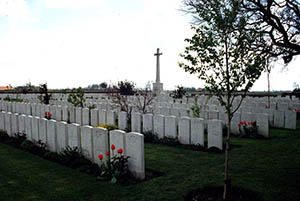
Buried at Mendinghem Military Cemetery, Poperinge, Belgium.
Mendinghem, like Dozinghem, and Bandaghem, were the popular names given by the troops to groups of casualty clearing stations posted to this area during the First World War. In July 1916, the 46th (1st/1st Wessex) Casualty Clearing Station was opened at Proven, and this site was chosen for its cemetery. The first burials took place in August, 1916.
At the start of the war, the British Army had no specific organisation for sapping (trench-digging), mining or tunnelling operations - such work was largely relevant only to sieges. But on December 20, 1914, at Givenchy, the Germans exploded 10 mines, planted under British positions by their sappers, By January 1915, it became clear that systematic German mining was under way, and the British responded by forming eight Tunnelling Companies the next month. Men with suitable experience London Underground excavators, miners or sewer workers were recruited, and a further 13 companies were later formed; these were joined by seven more specialist units from Canada, Australia and New Zealand.
Stockport Advertiser July 13th 1917
George Platt has died in hospital from wounds. He enlisted on August 4th 1916. George was a pony driver in Lord Vernon’s mines.
He was 21 years of age and single.
The 254th Tunnelling Company, Royal Engineers were formed in England. It moved to Gallipoli in December 1915, where it merged with the existing V111 Corps Mining company, but to late too have any serious impact on operations there.
They moved to France and relieved the 176th Company at Givenchy in the spring of 1916, before moving to Ypres in May, 1917. By June, 1917 the company were working in the Wieltje area of Belgium, constructing the Oxford Road, and Cambridge dug-outs. The Cambridge Road dugout systems were located within 100 metres (110yd) of the front line. It was connected to a vast mining scheme beneath Railway Wood and eventually became one of the most complex underground shelter systems in the Ypres Salient. Its mined galleries were named after London streets for easy orientation.
The Company were camped just outside the town of Poperinge. The war diary for the 19th states the camp was shelled at 8.30pm resulting in the following casualties:-
K.I.A
121976 Sapper William Green
136017 Sapper Isaac Lewis
146070 Sapper Alfred Skillman
80325 Dvr James Thomas
D.O.W
132934 L/Cpl William Austin
175888 Sapper Henry Chapman
175847 Sapper George Platt
Two further men were to die of wounds in the next 48 hours.
102582 Sapper William James Walters
79470 Sapper John Barr
THE BATTLE OF MESSINES
The Battle of Messines was launched on June 7, 1917, by British General Herbert Plumer's second army, near the villages of Mesen (in French Messines, as it was on most maps at that time). The target of the offensive was the Messines Ridge (a ridge running north from Messines village past Wytschaete village), a natural stronghold southeast of Ypres. General Plumer had begun plans to take the Messines Ridge a year before, in early 1916.
Over a period beginning more than a year before the attack, the attackers had tunnelled under the German trenches and planted almost 455 tonnes (1,000,000 lb) of ammonal there. A heavy bombardment of the German positions was initiated and then halted. The defenders returned to their positions expecting an assault to follow. The detonation of the explosives all timed for 3:10am, killed approximately 10,000 German soldiers. It said to have been heard as far away as London and Dublin and was possibly the loudest man-made noise made up to that date. In Switzerland, the explosions registered as an earthquake. The attack by the ground troops then followed. In total the British forces incurred 23,749 casualties, while the Germans suffered around 25,000.
Not all of the explosives went off. Two of the original 21 mines failed to ignite due to one reason or another. On July 17, 1955, a lightning strike set off one of the remaining mines, the only casualty being a dead cow. The 21st mine is believed to have been found in recent years, but no attempt has been made to remove it. Several large water-filled craters still mark the original positions of the German trenches.
Sapper William Hackett, a civilian miner, from Mexborough, Nottinghamshire was a member of 254 Tunnelling Company RE which in June 1916 were employed on mining operations at Givenchy, northern France. On 23rd June 1916, he was working with a shift of RE Miners and attached infantry labourers in a tunnel system known as the Shaftsbury Shaft. They were in tunnels about two-thirds of the way across no man's land when the enemy fired a mine in their vicinity, near what became known as Red Dragon Crater. As a result of the enemy's mine exploding Spr Hackett and his men were caught underground. Most of them were injured, Hackett being the only one able bodied, following the explosion. He helped 3 of his shift to their mine shaft and up the shaft to safety. His fourth team member, Pte Thomas Collins, 14th Bn Welsh Regt, also a miner, was trapped under fallen debris. A mine rescue party was soon on the scene, but Hackett refused to leave his pal. He is recorded to have said I am a tunneller, I must look after the others first. Due to further enemy action, the rescue party were compelled to withdraw, Spr Hackett remaining with Pte Collins. The rescue party tried to get to them for a few days after but failed and so Hackett and Collins remain in their tunnel today under the soil of French Flanders. As a result of his selfless act, Spr Hackett was awarded a posthumous VC. The ONLY VC to be awarded to a tunneller.
Cheshire County Memorial Project would like to thank Phil Underwood for compiling this page on George.