


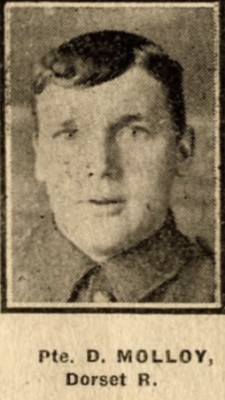
David's Story.
EARLY LIFE
David Molloy was born on 27th July and baptised on 15th August 1886 at St Alban's Catholic Church, Macclesfield, the son of Mary and Edward Molloy, a brewers labourer and publican originally from County Mayo in Ireland.
In 1891, 4 year old David was living at "The Pineapple" public house, 42 Watercotes, Macclesfield with his parents and siblings Mary Ellen (15), Margaret (13), Sarah (8), Thomas (6), Edward (2) and baby Eliza (3 months).
Ten years later the family had moved to 1 Court, 3 House, Allen Street, where Edward was employed as a bricklayer's labourer and three of his sons, including fourteen year old David, were working as cotton weavers.
David emigrated to America, leaving Liverpool on the S.S. Saxonia on 10 May 1910. The passenger list names him as David Malloy (sic) and records that he was a weaver, his next of kin was his mother, Mary Molley (sic), of 1 Court 3 Allen Street, Macclesfield and his final destination was Boston, Massachusetts.
WW1 SERVICE
David was still in America when war broke out; he returned to England and enlisted in London at the beginning of October. On 19th December 1914 he joined the Dorsetshire Regiment in Dorchester, Dorset, stating that his address was 5 Lowe Street, Macclesfield. In his army service papers he declared that he had previously served for 1 year with the Cheshire Militia and was employed as a general labourer. David's medical assessment described him as 5 feet 7 inches tall, weighing 150 pounds with a 36 inch chest measurement.
David entered France with the British Expeditionary Force on the 18th February 1915. He received a gunshot wound to the head and was admitted to a hospital in Boulogne on 30th March 1915, and was transferred to a convalescent camp in Boulogne to recuperate a few days later on 4th April. David was admitted to a hospital in Rouen for 3 days on 20th April, suffering from Urticaria (Hives), an allergic reaction causing an itchy skin rash which can be triggered by stress.
On 2nd May David, along with many hundreds of his comrades - 130 of whom died - was a victim of gas poisoning. He was treated by the 14th Field Ambulance Unit and then transferred to the 15th Field Ambulance Unit. David recovered and rejoined his battalion on 7th May. On 9th June 1915 the Western Times printed a list of men from the 1st Dorset Regiment who had been affected by the gas, which included Private D. Molloy. Private H. H. Morris of Birmingham, serving with the Warwickshire Territorial Ambulance, RAMC, treated some of the Dorset Regiment victims of the gas attack and his letter describing his experiences was printed in the Birmingham Evening Despatch on 29th May 1915:
"Our ambulance at present is doing good work - one section working an isolation hospital, and another some baths. The baths, of course, are crude, but provide a bath for a thousand troops a day.
Each soldier is given a complete change of underlinen in exchange for the dirty set - which are sterilised, washed, and used again. This is a very useful innovation, especially for troops returning from the trenches. Another section is working night and day loading wounded from the casualty clearing station to the train by which they are conveyed to the base hospitals and, later, to England; and two other sections are working a hospital and convalescent home.
9 May - a fortnight ago saw the first victims of ... gas poisoning. It is awful, pitiful, heartrending to see patients struggling for life destroyed by this hideous gas. Cases have been coming in by the dozen, and it was the very helplessness that was grievous in dealing with the first few batches.
The gas has an instant effect on the lungs and bronchial tubes, which become blistered and full of gas bubbles, and the patient lies gasping and fighting for breath, but conscious to the last. In many cases the patient goes a sickly blue colour; on his lips a green bubbly fluid charged with gas. ... A little wooden cross bearing the words 'Pte W. Jones, 1st Dorset Regiment. Died of gas poisoning' marks the last remembrance of another victim."
David Molloy survived the gas attack, but was killed in action on 5th July 1915. His death was reported in the Macclesfield Times on 23 July 1915:
We record with regret the death of another Macclesfield soldier... David Molloy, a private in the 1st Battalion Dorset Regiment. His widowed mother, who lives at 35 Lowe St, Macclesfield received the sad news that he had been killed in action (on July 5th) on Friday last.
The late Private Molloy was in America, where he had been for four and a half years, when the war broke out. Returning to England, he enlisted in London in the first week of October, and as he had had previous military training in the old Militia, it was not long before he was drafted to the front, where he had been about five months when his death occurred. He had been wounded and gassed some time prior to being fatally shot. His brother, Sergeant T Molloy is serving with the 7th Batt Cheshire Regt, and he has a brother-in-law, Quartermaster-Sergeant Cassidy, of the King's Own Scottish Borderers, who is now in France.
After going to France, Private Molloy wrote several letters home describing his experiences. In one of these he mentioned having carried a wounded comrade a mile and a half, and that his friend died on the journey. Writing on May 7th, he stated: "We were in the Hill 60 affair, and the Germans used gas on us. We had an awful time... If you had seen our men after it, it would have made your blood run cold. But we are not downhearted; it will come our time some day... I was in hospital three days suffering from the effects of gas."
In a letter dated June 29th, Private Molloy refers to the bombardment of Ypres. "A very strange thing happened," he said. "They knocked the Cathedral down, but did not touch a statue of our beloved Lady, which is still standing."
NOTES
David Molloy is mistakenly named as Daniel Molloy in some of the records.
COMMEMORATION
Private David Molloy is buried in grave ref. II. J. 16. in Larch Wood (Railway Cutting) Cemetery in Belgium.
The Commonwealth War Graves Commission holds casualty details for Private David Molloy, and he is listed on the Imperial War Museum’s Lives of the First World War website.
In Macclesfield, David Molloy is commemorated on the Park Green, Town Hall, St Michael's Church, St George's Church and St Alban's Church war memorials.
Research by Rosie Rowley, Macclesfield.