


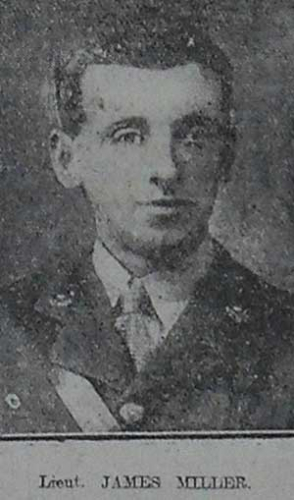
James's Story.
Birkenhead News 02 November 1918GALLANT YOUNG OFFICER’S SACRIFICE.
Lieutenant James Miller, of the Cheshire Regiment, of whose death in action, on the 14th ult., official notification was received from the War Office a few days ago.
At the outbreak of war, he was a Sergeant in the Cheshire Territorial Forces, in which he had served from the date of their inception, and prior to that event he was a member of the old Volunteer Force. Immediately after the mobilisation of the Territorial Forces, he volunteered for foreign service.
After experiencing all the terrors of war in the awful landing at Suvla Bay, and taking part in the subsequent operations in Gallipoli, he returned to England and obtained a commission in the Cheshire Regiment.
From that time onwards until his death, he served continuously in France. The excellence of his work there earned the high praise of his superior officers and, some few months ago, brought him the reward of promotion to the rank of full Lieutenant.
Thus he was no stranger to the art of war , and it is evident that he brought to bear upon his work as an officer the qualities of sound knowledge, resourcefulness, and, what is perhaps of greater moment in a leader, that wise and sympathetic understanding of men which does so much to capture their affections.
In a letter of condolence (addressed to the brother of the dead officer, who is now training in England) Lieutenant Miller’s Commanding Officer writes –
“Your gallant brother was killed in action. In sending you the sincere sympathy of all the officers, N.C.O.’s, and men of the Battalion, I must also express my own great sorrow. Your brother was a brave and reliable officer, and he has done great work since joining my Battalion. His men were very fond of him, and would follow him anywhere. When we attacked there were several nests of enemy machine guns, which caused us casualties. One of these was attacked by your brother and a handful of his men. He was killed, unfortunately, but the men he led carried on and killed the Germans, thereby saving the lives of many of their comrades. And preventing our advance being held up ….. He died a soldier’s death and did his duty.”
Such is the last tribute from a soldier to a soldier, and those who knew the man of whom these words have been written will best realise how well they are deserved. Countless are the young lives which have been brought to an untimely close, in this greatest of all wars, there can have been few which showed greater promise or a fairer record of duty nobly done than that of this gallant boy. Though his latter days were saddened by domestic griefs of no ordinary kind, for only a few months before his death he buried his young wife, he bore the agonies and brutalities of war with a rare courage and selflessness to the end that, through him, we might live, and the remembrance of his manly and engaging personality will live long with those who were privileged to feel its charm.
The deceased was an old boy of Claughton Higher Grade School, to which he was always attached by sentiments of the strongest loyalty. In business he was in the service of Messrs. Keightley, Banning and Goodwin, of Liverpool, and by them was regarded with feelings of the highest esteem and affection. The news of the death came upon them with painful suddenness, as, during his last leave, which expired so recently as the end of September last, he saw them frequently and spoke most optimistically of the general position on the Western Front, and of the possibility of his early return to the office.
That, after complete immunity from accident throughout nearly four years and a half of unbroken service, he was called upon to make the great sacrifice just when there appeared to be the first real promise of the end of the present bloody struggle served but to give point to the melancholy reflection that like his end must be that of many other fine fellows who, in all the glory of youthful vigour, are now fighting in France and elsewhere.
James Miller’s photograph and newspaper article by Chris Booth